I built a boss that reads your board and takes your favourite tower away
Most tower-defense bosses just hit harder. Mine watches what you build and counters it — disabling whatever tower type you lean on, again and again, until you diversify. The whole 'smart enemy' is ~50 lines and zero new AI.
Most tower-defense bosses are a bigger HP bar with a scary name. You build the wall you always build, watch the chunky guy crawl into it, win. The trouble with a bigger number is that it doesn’t punish you — it punishes the clock. You play the exact same way, just longer. I didn’t want that for the final secret world of Overserved.
I wanted a boss that watches what you build. And then takes it away.
A capstone, not a re-run
The whole game, you serve an AI — feeding it, satisfying it, keeping it happy. The capstone world flips that. The AI got abandoned, and it stopped asking to be served and started demanding to be needed. The tagline I’d written months earlier: “It has read your every move.”
A flat difficulty bump can’t sell that line. The bosses people actually remember don’t punish your reflexes — they punish your habits, the lazy default you reach for every level. So the brief wrote itself: build something that reads the board and counters your real strategy.
The thing that watches
On the final world, an invisible clock ticks while a wave is alive. Every tick it tallies your towers by type, finds the one you’ve built most, and asks one question: what is this player leaning on? Then it picks a counter.
One-trick board? If any single tower type is 40% or more of your fleet, that’s the one it takes — it disables that whole type for about eight seconds. They come back. Re-spam them and it just takes them again. You don’t get to brute-force the level with one beloved tower.
Spread thin instead? Then there’s no single type to punish, so it starves you — it slashes your compute economy to a fifth, and the wide, expensive board you built suddenly can’t pay its bills.
Neither? It heals the live wave, shoving the enemies back toward full, and the amount grows every time it does it.
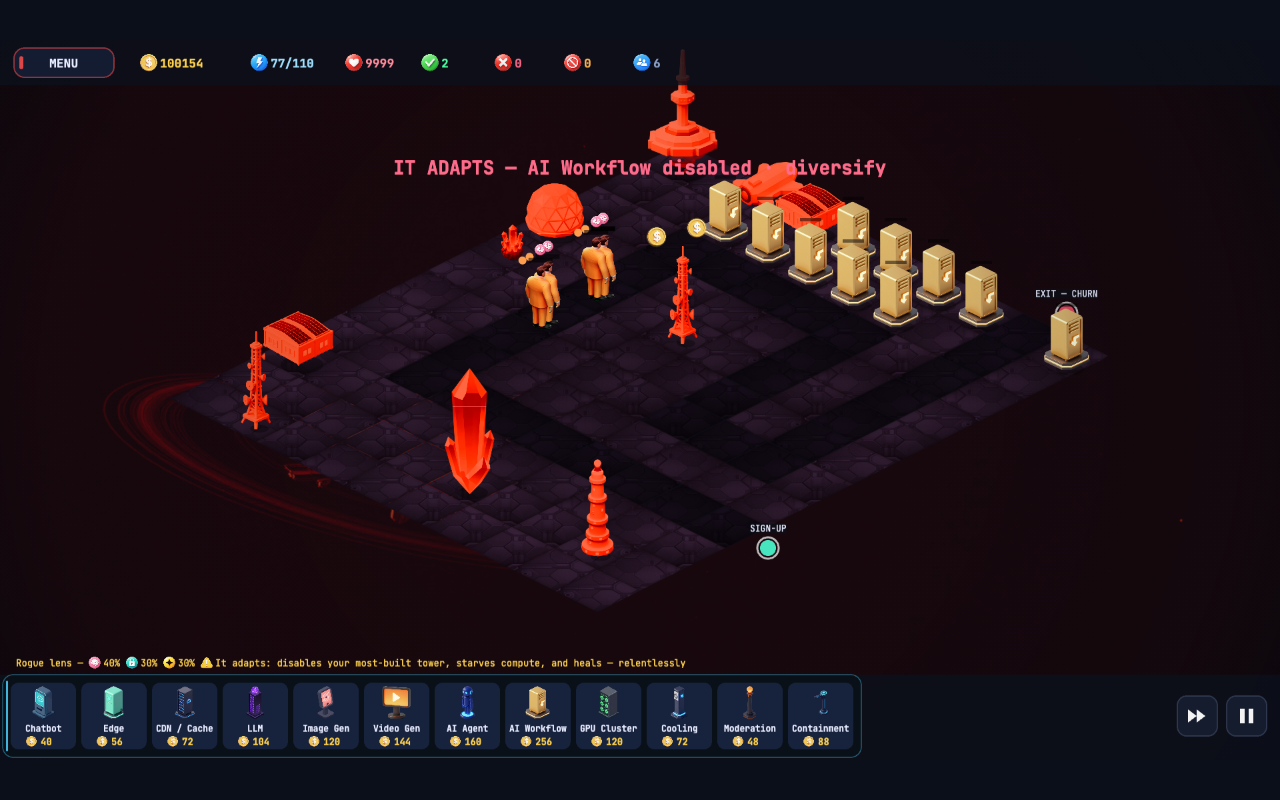
Here’s the moment it fires on a one-trick board — ten of the same tower greyed out at once:
I tested it against the most stubborn board I could build: nine identical towers, nothing else. It picked them off one adaptation at a time — all nine gone in about five hits. The board forces you to diversify. That’s the entire point: the counter isn’t aimed at your towers, it’s aimed at your strategy, so the only way out is to stop having just one.
Making it feel alive, not unfair
A board that confiscates your towers reads as either a bug or a cheat. Two things stop that.
It escalates as it learns. The clock tightens with every move it makes — it starts hitting once every eleven seconds and ramps down to once every five and a half. The heals grow alongside. It feels like something getting angrier, because mechanically that’s exactly what the curve is doing.
And it’s loud. Every adaptation throws a giant “IT ADAPTS” banner across the screen, shakes the camera, and plays the boss sound. That telegraph is the whole difference. Silent, the game just eats your towers and you feel robbed. Loud, you read the counter and adjust — and now it’s a duel. Same mechanic, opposite feeling. Adversarial systems have to announce themselves, or players file them under “broken” instead of “beat me fair.”
The part I’m smug about
The headline feature of the entire game — the boss that reads your strategy — is about fifty lines of code. Not fifty lines plus a new AI system. Fifty lines, full stop.
Because it doesn’t do anything new. Disabling a tower type, draining the economy, healing a wave, shaking the camera — every one of those already existed in the game as a separate little tool I’d built for something else. The “AI” is just a controller sitting on top: read the board, pick which existing lever to pull. The intelligence isn’t in any clever new code. It’s in the if/else that decides which old code to fire, and when.
That’s the lesson I keep relearning, and it’s the opposite of where the instinct goes. The instinct says smart enemy → build a smart system. But before you build new machinery, check whether the thing you want is already lying around in pieces. Mine was. The novelty was the arrangement.
A whole world, recoloured by a script
The corrupted realm needed to look corrupted — red, black, wrong. The honest move would’ve been to generate a fresh art set: background, comic panels, decor, tiles, the boss. Days of work. Instead I took the existing endgame art and ran every piece through a tiny colour-math script — about thirteen lines.
The order is the whole trick. Tint a cyan-heavy image red and the two colours fight; you get mud. So the script desaturates first — knocks out roughly two-thirds of the saturation to kill the original’s signature cyan — then multiplies in a red-dominant tint, and finally keeps the brightest cores glowing hot so they read as red-orange instead of grey. Strip the colour, then recolour. One pass over every asset, zero new images generated.
The one thing that nearly broke it was the boss. I’d left it pointing at the old blue endgame titan, and a bright blue monster on a blood-red board doesn’t read as a boss — it reads as a rendering bug. So the same script went over the titan too. When you drop reused art into a new context, re-tint it to match, or the mismatch looks like something’s broken rather than like a callback.
A full secret final world — new mechanic, new look, balance-tested — built and shipped in a day. The smartest enemy in the game, and there’s no actual AI behind it. Just fifty lines that pay attention.